Beyond the Headlines: What Toronto's Public Conversations Reveal Ahead of the 2026 Municipal Election
Days away from the Municipal Election Day of October 26, familiar issues are dominating public discussion: housing affordability, transit, property taxes, community safety and development.
But knowing what people are talking about is only part of the picture.
Why do these issues matter? What's driving public sentiment? And how are conversations changing across communities?
These are the questions we're exploring through Community Pulse, our AI-powered social listening engine within the PredictEdge engagement intelligence platform.
What Toronto's Conversations Are Telling Us
In a preliminary demonstration, we examined public YouTube conversations across six selected Toronto wards.
Our Community Pulse dashboard identified:
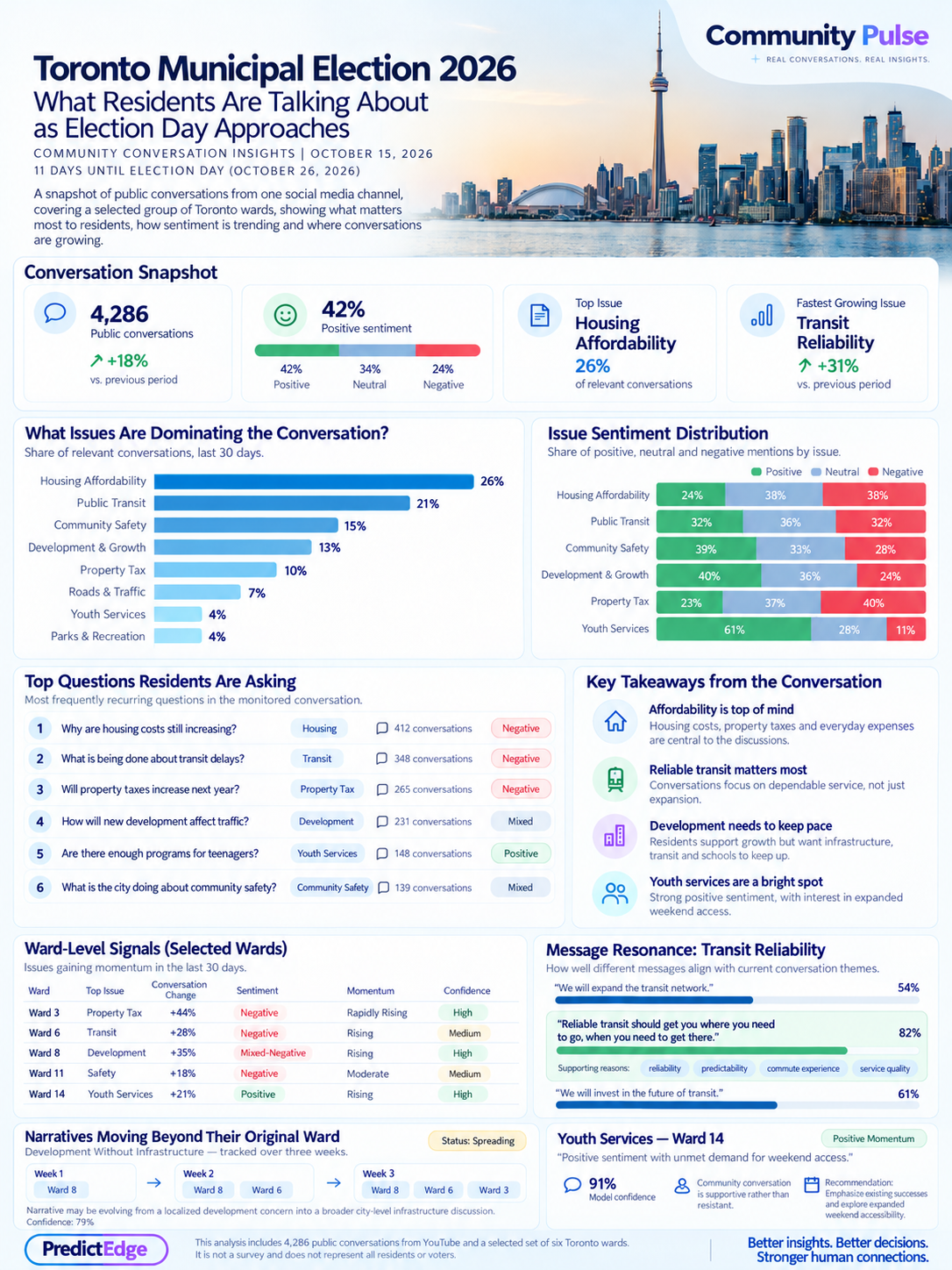
4,286 relevant conversations, up 18% from the previous period.
42% positive sentiment, compared with 34% neutral and 24% negative.
Housing affordability as the leading issue, accounting for 26% of conversations.
Transit reliability as the fastest-growing concern, increasing 31%.
These early findings are directional, not representative of Toronto's electorate, but they illustrate how AI can help identify emerging patterns and underlying community concerns.
Beyond the Issues: Understanding the Why
Affordability is about more than housing.
Discussions about housing costs, property taxes, transit expenses and municipal spending often point to a broader concern: the rising cost of everyday life and whether residents feel they're getting value from public services.
Transit is about reliability, not just expansion.
Our narrative-alignment analysis found that a statement emphasizing reliable, predictable transit aligned more closely with monitored conversations (82%) than statements focused on network expansion (54%) or future investment (61%).
These scores measure thematic alignment within the sample, not voter support or message effectiveness. They nevertheless illustrate an important distinction between identifying an issue and understanding the practical needs behind it.
Local concerns can become broader conversations.
Over three weeks, our analysis tracked the narrative “development without infrastructure” appearing first in Ward 8, then in Wards 6 and 3.
The conversations connected development with concerns about roads, transit, schools and community infrastructure. While this does not establish that discussion spread directly between wards, it identifies a pattern worth investigating.
Not every emerging conversation is negative.
In Ward 14, relatively positive discussion about youth services also revealed interest in expanded weekend programming.
Residents can value a service while identifying unmet needs. Similarly, concerns about development don't necessarily mean opposition to growth.
These nuances are often missed when we rely solely on positive, neutral and negative sentiment.
From Social Listening to Engagement Intelligence
Having worked in political campaigns and led marketing and communications teams, I've seen firsthand how organizations collect enormous amounts of data but struggle to understand what people genuinely care about and why. That's why I founded PredictEdge.
Community Pulse, the social listening engine within the PredictEdge platform, goes beyond tracking mentions and sentiment to uncover emerging issues, underlying motivations and evolving community narratives.
Built with compliance, explainability, traceability and human oversight, insights can be traced back to their original public content, allowing organizations to validate findings and make more informed decisions.
While Toronto's municipal election provides a timely example, the applications extend across sectors, from helping governments understand community needs and nonprofits identify emerging issues to helping educational institutions and businesses better understand the people they serve.
The challenge is universal: organizations have more data than ever, but often lack the intelligence to understand what it means.
Our early Community Pulse demonstration offers a glimpse of what's possible when we move beyond monitoring conversations to understanding the motivations behind them.
Because understanding people isn't just about knowing what they say. It's about understanding what matters to them and why.
Better insights. Better decisions. Stronger human connections.
Methodology note: This preliminary demonstration draws on one monitored social media channel and six selected Toronto wards. Findings are directional, not representative of residents or voters, and are not an election forecast. Underlying demonstration records and AI-generated classifications require source validation and human review before being treated as verified research.